LTA Mayor Harmancı meets with neighborhood heads
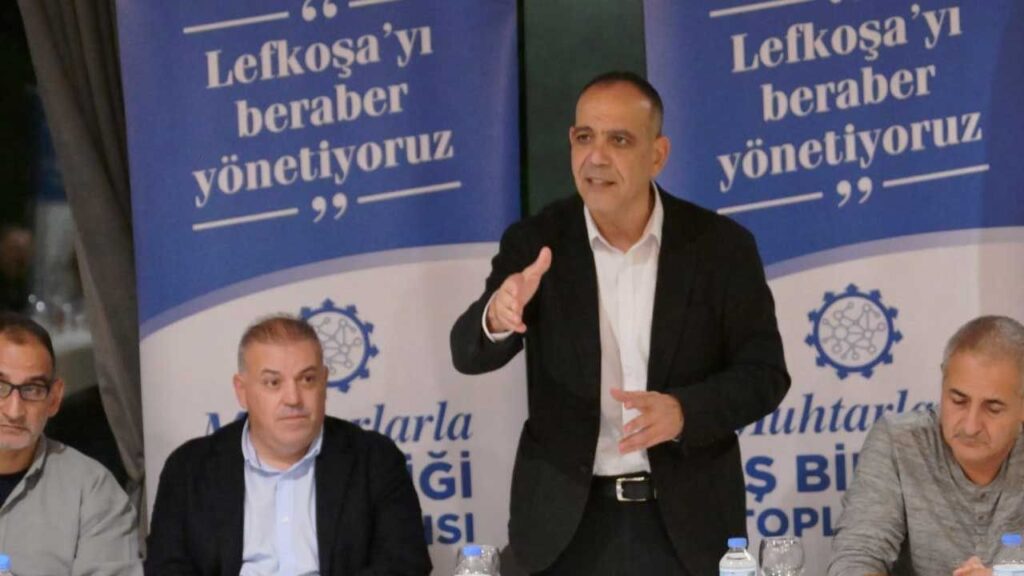
According to a statement issued by the Nicosia Turkish Municipality (LTA), Mayor Mehmet Harmancı met with neighborhood heads (muhtars) at an event attended by municipal council members.
Highlighting the role of muhtars in city management, Harmancı stated that the cooperation and solidarity established with them contribute to the development of Nicosia.
Touching upon the importance of the Muhtars Coordination Center, which was established to improve cooperation and maintain constant dialogue with muhtars, Harmancı thanked Ali Ülker, the officer in charge of the branch, for his efforts.
Congratulating all muhtars on the occasion of October 19 Muhtars’ Day, Harmancı thanked them for their dedicated work so far.
Stating that they have worked together with municipal council members throughout their term by taking all regions of the city into consideration, Harmancı said that the needs of each neighborhood were taken into account while preparing annual budgets.
Expressing that different works have contributed to every neighborhood, Harmancı noted that significant services have been carried out across the city through investments such as asphalt paving, playgrounds, infrastructure, sewerage works, and rainwater drainage. Harmancı also thanked the municipal council members for their efforts and contributions during this process.
Emphasizing that the strong cooperation and solidarity established with muhtars played a role in the point Nicosia has reached today, Harmancı said that the guidance and contributions of muhtars are of great importance to them.
Stressing that the muhtar system should not be evaluated solely based on salaries, Harmancı recalled that during the local government reform process that came to the agenda in 2022, they advocated for muhtars to establish a stronger relationship with local administrations. He also reminded them of their proposals to create a separate assembly where muhtars would be represented and to give them a say over budgets.
Stating that the reform remained largely limited to geographical regulations and that expected developments regarding the functioning of the muhtar system could not be implemented, Harmancı listed the failure to transition to an electronic system and the inability to accurately generate population data among major problems.
Stating that the healthy determination of population policies is of great importance in terms of determining the investment priorities of cities, Harmancı expressed that under current conditions, it has become difficult for muhtars to accurately track the residence information and current status of all voters.
Stating that central governments must implement regulations to ensure the creation of accurate and up-to-date data, especially regarding residence records, Harmancı emphasized the importance of establishing the necessary legal and administrative infrastructure for muhtars to perform their duties more effectively.
Stating that the continuation of the muhtar system under current conditions is not sustainable, Harmancı expressed that the system must be strengthened and legal regulations suitable for today’s conditions must be made. Harmancı noted that strengthening the powers and responsibilities of muhtars will also contribute to the service capacity of local governments.