Taçoy shares messages on economy, energy, and elections: Our goal is to make citizens’ lives easier
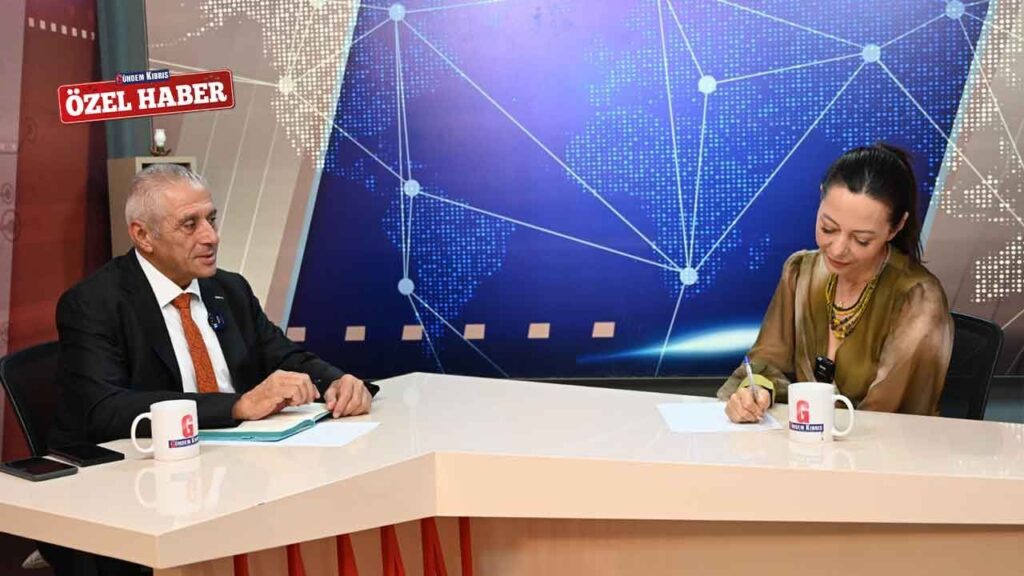
Economy and Energy Minister Hasan Taçoy was a guest on Gündem Kıbrıs WEB TV, hosted by Editor-in-Chief Çiğdem Aydın. Answering questions regarding his ministry’s ongoing work and the country’s agenda, Taçoy stated that from his very first day in office, he faced fuel price hikes, along with strikes by El-Sen and Turkish Petroleum, emphasizing that his priority is to ensure citizens have uninterrupted access to basic needs.
Highlighting the need to protect economic balances, Taçoy noted that in the fight against the cost of living, it is important not only to lower prices but also to establish a balance among suppliers, retailers, and consumers.
Evaluating the developments during his first days in office, Taçoy explained that he had to raise fuel prices on his first day, which was followed by a strike at the Cyprus Turkish Electricity Authority (KIB-TEK).
Stating that it is his responsibility to deliver energy and fuel services to citizens without interruption, Taçoy said that long-term power outages, in particular, caused serious grievances.
Recalling that a family with three children in Taşkınköy was left without electricity for eight days, Taçoy noted that they made intensive efforts to resolve the problems caused by the strike.
Stating that power outages were not limited to specific regions, Taçoy noted that similar difficulties were experienced in many parts of the island and that resolving citizens’ grievances is among their priorities.
Addressing the work stoppage in the petroleum sector, Taçoy explained that Altınbaş Petrol won the tender held about 6-7 months ago to supply jet fuel to aircraft at Ercan Airport, while K-Pet lost the tender.
Stating that nine employees of K-Pet working in this field decided to stop work, Taçoy said that the legal dimensions and authority regarding this decision should be evaluated by the relevant institutions.
Expressing that the Arbitration Board was called to a meeting by the Ministry of Labor, Taçoy emphasized that the developments would not disrupt the fuel supply in the country.
Giving assurances to citizens against claims that there would be a shortage of fuel or cylinder gas in the market, Taçoy stated that if one supplier fails to provide products, other suppliers can step in.
Making assessments regarding fuel prices, Taçoy stated that prices are determined according to developments in international markets, and therefore no definitive commitment can be made that there will be no price changes in the future.
Noting that fuel prices depend on movements in world exchanges, Taçoy stated that possible changes will be shared with the public after necessary calculations are made.
Reminding that statements were also made by the Greek Cypriot Administration leader Nikos Christodoulides attributing energy price hikes to international markets, Taçoy pointed out that price changes are not shaped solely by local administration decisions.
Taçoy expressed that in line with current assessments, he does not expect high-rate hikes in either fuel or cylinder gas.
Providing information on the studies announced by Prime Minister Ünal Üstel aimed at lowering prices in basic consumer goods, Taçoy said the goal is to reduce costs particularly in baby and children’s products targeting the 0-12 age group and in certain basic necessities.
Stating that the necessary analyses and reports have been completed within the ministry, Taçoy announced that meetings will be held with suppliers and relevant industry representatives in the next stage.
Pointing out that baby diapers, baby formula, and certain cleaning products can be sold cheaper in South Cyprus, Taçoy stated that one of the reasons for this is the difference in transportation costs.
Stating that the issue has been discussed with the Ministry of Finance and the Prime Minister’s Office, Taçoy said the economic consequences that would arise if VAT is zeroed out or reduced have also been calculated.
Emphasizing that the effects of the regulations to be made are being evaluated both in terms of public finance and consumers, Taçoy highlighted that their main purpose is to reduce citizens’ daily living costs.
Explaining that the TRNC has its own unique economic conditions, Taçoy said the country’s closed economy structure has an impact on prices and supply processes.
Stating that a difference in economic terms has emerged between citizens who can cross over to South Cyprus to shop and those who do not have this opportunity, Taçoy expressed that university students and foreign workers, in particular, are forced to meet their needs from the northern market.
Noting for this reason that Northern Cyprus must be made a more attractive shopping center in terms of price and product variety, Taçoy said they aim to create a more affordable market compared to South Cyprus.
Taçoy stated that with falling prices, consumption and sales volume could increase, which would produce positive results for suppliers, sellers, and consumers.
Addressing price differentials in the market and inspection activities, Taçoy announced that they aim to increase inspections as a ministry.
Stating that inspections are currently being carried out by 15 teams, Taçoy said market discipline needs to be strengthened in the country.
Pointing out the importance of tracking potential differences between shelf prices and prices in the ‘Eco Basket’ application, Taçoy stated that efforts are underway to make inspection processes more effective and online.
Expressing that he has left behind about a month in office, Taçoy noted that in line with his observations, he will initiate a new meeting process with industry representatives.
Emphasizing that the purpose of inspections is not to fine businesses, Taçoy said they aim to ensure that the market operates in a balanced manner and that citizens feel confident about prices when shopping.
Explaining that direct intervention in prices is limited in a free-market economy, but the state has certain regulatory powers, Taçoy stated that products can be included in the scope of controlled goods when necessary.
Giving fire extinguishers required to be kept in vehicles as an example, Taçoy stated that they included these products in the scope of controlled goods, and although they did not set prices directly, market prices became balanced.
Expressing that the same method can be applied again in similar situations, Taçoy noted that the Trade Department is closely monitoring developments in the market.
Stating that VAT reductions, controls on import freight costs, and fund regulations are also being evaluated, Taçoy emphasized the importance of implementing these steps without negatively affecting local production.
Responding to criticisms regarding inspections carried out at stationery stores during the opening period of schools, Taçoy said inspections should not be evaluated solely through instantaneous results.
Stating that significant information and data accumulation has been obtained as a result of the work done, Taçoy expressed that the prepared reports will allow next year’s inspections to start earlier.
Noting that starting inspections in the stationery sector one or one and a half months before the school season could be more effective, Taçoy explained that he wants this approach to be transformed into a permanent working system.
Evaluating economic developments, employment, and wage increases in the country, Taçoy said the economy cannot be addressed solely through salary increases.
Stating that the increase in the number of retirees must be evaluated together with the working population and production capacity, Taçoy expressed that supply and demand balance will play an important role in economic planning for the next five years.
Noting that significant increases occurred in wages in 2024 and 2025, while a more balanced outlook emerged in 2026, Taçoy drew attention to the increase in deposit and credit volume in banks.
Stating that the rate of non-performing loans, which was previously around 5.5-6 percent, has dropped to 2.5 percent, Taçoy evaluated these developments among the indicators of economic growth.
Expressing that it is not right to reflect the increase in the minimum wage onto all product and service prices at the same rate, Taçoy emphasized that economic decisions must be made taking all balances into account.
Noting that opening new business areas, creating employment in different sectors, and developing tourism are important for economic growth, Taçoy said growth in tourism must be supported by increasing accommodation capacity and transportation opportunities.
Touching upon public reform and union rights, Taçoy argued that current union legislation needs to be re-evaluated.
Explaining that during his education in the US, he took courses on unionism and labor relations, Taçoy said union organization does not consist solely of the right to strike.
Arguing that there are deficiencies in legal regulations in the TRNC, Taçoy stated that citizens’ access to basic services must be guaranteed just as much as the protection of union rights.
Pointing to practices in Europe, Taçoy expressed that strikes and union activities must be addressed together with the continuity of public services.
Noting that he is not against unions, but that it is important to make legislation more comprehensive and qualified, Taçoy emphasized that the services citizens ought to receive must not be blocked.
Making statements regarding the economic and social policies of the UBP, Taçoy said the legal and budgetary infrastructure of the support and projects announced by Prime Minister Ünal Üstel is being prepared.
Stating that social practices such as nursery support have a karşılığı (provision) in the budget, Taçoy argued that the program announced by the government contains important regulations in terms of social policy.
Expressing that the year 2027 is planned as the year of youth, Taçoy stated that projects are emphasized that will ensure young people stay in the country, work in the fields they were educated in, and participate more strongly in economic life.
Noting that the UBP envisions an increase of 50,000 jobs in the next five-year period, Taçoy argued that this target is not just an election promise, but part of a long-term development program.
Answering questions about the election atmosphere and public opinion polls during the program, Taçoy made evaluations regarding the problems the UBP experienced in past periods and the current status of the party.
Recalling the 2003 election process, Taçoy stated that citizens can directly show their satisfaction or reaction toward political parties.
Acknowledging that the UBP displayed a disorganised image until a few months ago, Taçoy argued that the debates within the party were not a struggle for seats, but an effort to establish a better management approach.
Stating that the party has entered a recovery process in recent months, Taçoy said the UBP has not yet reached its targeted point, but is in a stronger position than it was two months ago.
Expressing that if elections were held today, the UBP could emerge as the second party or achieve a result equal to its rival, Taçoy stated his belief that this picture will change until the election date.
Arguing that the UBP will emerge as the first party from the elections on December 6, Taçoy said the party will face voters with its projects and deeds.
Stating that voters will make evaluations based on both positive and negative developments, Taçoy expressed that the UBP grassroots has the power to unite during election periods.
Touching upon young cadres within the party, Taçoy said there are many young people in the UBP who are interested in politics and want to contribute to the country. Stating that the younger generation needs to become more visible in politics, Taçoy noted that the UBP will face society in the upcoming period with both its economic projects and young cadres.